01 · Unemployment increased sharply
Unemployment rose from about 5% before the pandemic to 10.26% in 2020. Employment fell from 94.89% to 89.74%, while the number of unemployed people grew from about 2.26 million to 4.50 million.
PROJECT 01 · EXCEL LABOR MARKET ANALYSIS
A study of employment and unemployment in the Philippines from 2016 to 2025, showing how the pandemic affected workers, how men and women were affected differently, and how the labor market recovered.
Role
Data cleaning · analysis · reporting
Tools
Excel · Power Query · Pivot Tables · Slicers
Source data
Philippine Statistics Authority Labor Force Survey
The dashboard puts the results in one view. Users can compare the years before, during, and after the pandemic and check the results by year and gender.
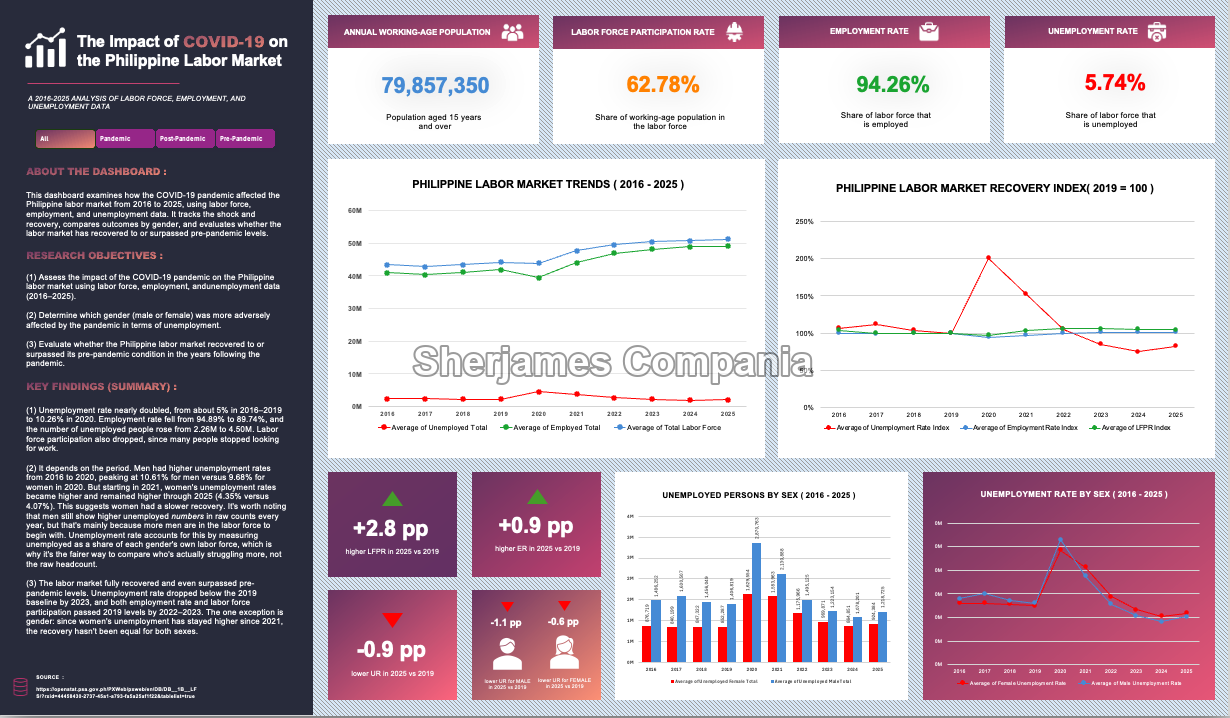
I cleaned the PSA data in Excel Power Query. I removed monthly records and unused fields, kept the years 2016–2025, made the column names and formats consistent, and changed the counts from thousands to full numbers.
The results show the size of the pandemic’s effect, the overall recovery, and the areas where recovery was not the same for everyone.
Unemployment rose from about 5% before the pandemic to 10.26% in 2020. Employment fell from 94.89% to 89.74%, while the number of unemployed people grew from about 2.26 million to 4.50 million.
Men had higher unemployment rates from 2016 to 2020, reaching 10.61% in 2020 compared with 9.68% for women. From 2021 onward, women had the higher unemployment rate through 2025.
Unemployment fell below the 2019 level by 2023. Employment and the share of people in the labor force also passed their 2019 levels around 2022–2023.
By 2025, female unemployment was 4.35% compared with 4.07% for men. The number of unemployed men was higher, but rates give a fairer comparison because the two groups have different labor force sizes.
Explore the Excel files, screenshots, calculations, and project notes on GitHub.
Philippine Statistics Authority — OpenSTAT
Labor Force Survey results by sex, reported yearly from 2016–2025